For years, I’ve loved tinkering with all kinds of knowledge tools.
See a good article? Save it first. Hear a sharp insight? Jot it down fast. Switch to a new tool? I can’t resist redesigning my categories, tags, and search setups all over again. Producing content, building workflows, organizing knowledge bases—none of this is foreign to me.
Sometimes looking at my knowledge base, it really does look like a subway map: categories constantly branching, tags growing ever more granular, interconnected in every direction.
But whether these tools actually work comes down to just one thing for me now: when it’s time to write an essay, build a product, or solve a problem, does all that stuff I diligently saved actually help?
Dan Koe recently wrote a long essay that opened with just two sentences:
“If something requires deliberate effort to remember, it’s not important. If it’s important, you’ll naturally remember it.”
That stung a bit.
It definitely nailed some of my bad habits, but I also think it’s wrong.
It Makes Some Sense, but It’s Also Wrong
I don’t entirely agree with Dan Koe.
You forget important things just the same. You forget them over time, when you’re burned out, or when too many things pile up. A name, a commitment, or even a book that genuinely shaped you—a few years later, all that might be left is a hazy impression. Forgetting something doesn’t mean it wasn’t important, nor does it mean you didn’t learn it in earnest.
I dug through some research papers and looked up whatever I could find online. To put it bluntly: rereading something over and over usually just makes it look more familiar. If you really want to remember something longer, you have to close the original, try explaining it yourself, and see where you got it wrong. Feeling like you “got it” is a completely different thing from actually being able to explain it and put it to work.
So that opening statement is simply flawed.
Yet why did it still hit a nerve? Because I do this all the time: mistaking “saved” for “understood,” and casually telling myself I learned a little more today.
In reality, nothing probably happened in between.
Hitting Save Brings Instant Peace of Mind
Halfway through an article, thinking you might need it later, you hit bookmark and instantly feel at ease. Before you’ve even finished reading, that nagging fear of “what if I can’t find this later” disappears. And once it’s safely tucked away, it’s that much easier to tell yourself: I’ll read it later.
Over time, your bookmarks, read-later apps, and note vaults become stuffed with things you plan to “read carefully later.” They sit like a stack of unopened deliveries—too precious to throw out, yet none urgent enough to actually unbox.
The next time I search for material, these bookmarks resurface in bulk, reminding me how much I still haven’t read and haven’t digested. The more I save, the heavier that sense of debt becomes.
I used to believe that saving first could never hurt. Only later did I realize that once the stash piles up, just deciding what to read first is exhausting enough.
Christian Tietze calls this the “Collector’s Fallacy.” Simply put: knowing where something is stored is a far cry from actually understanding it.
I’ve messed with plenty of systems. Categorization, search, AI retrieval—they can certainly surface old notes. But that only proves I’ve encountered the idea before; it doesn’t mean it has become my own.
Search can retrieve the original wording, but it can’t think through the real questions for me: Do I actually buy this? Does it line up with my experience? What’s the real cost of putting it into practice?
In the end, you still have to think through those things yourself.
Especially when creating content, there’s always far more material than you can ever get through, and these takes constantly contradict one another. In the end, which claim I stand behind and which I reject is a choice I have to make. Tools can lay the materials on the table, but they won’t make that decision for me.
You Only Know What You’re Missing When You Need to Use It
There’s one point in Dan Koe’s essay I strongly agree with: most people get the order of learning completely backwards. Telling people to “delete your note-taking system” was just him being deliberately provocative.
When most people want to learn something new, their first reflex is to track down a comprehensive course. They start from the basics, underlining conscientiously, terrified of missing a single concept. They watch a ton and take plenty of notes. Yet the moment they close the course, they still have no idea where to start.
Actually building something is a completely different story.
When I try to put a visual together, I quickly hit a wall with some feature I don’t know how to use. Halfway through drafting an essay, I realize an earlier section made no sense at all. Hand a product to users, and an entry point I thought was crystal clear turns out to be completely invisible to them.
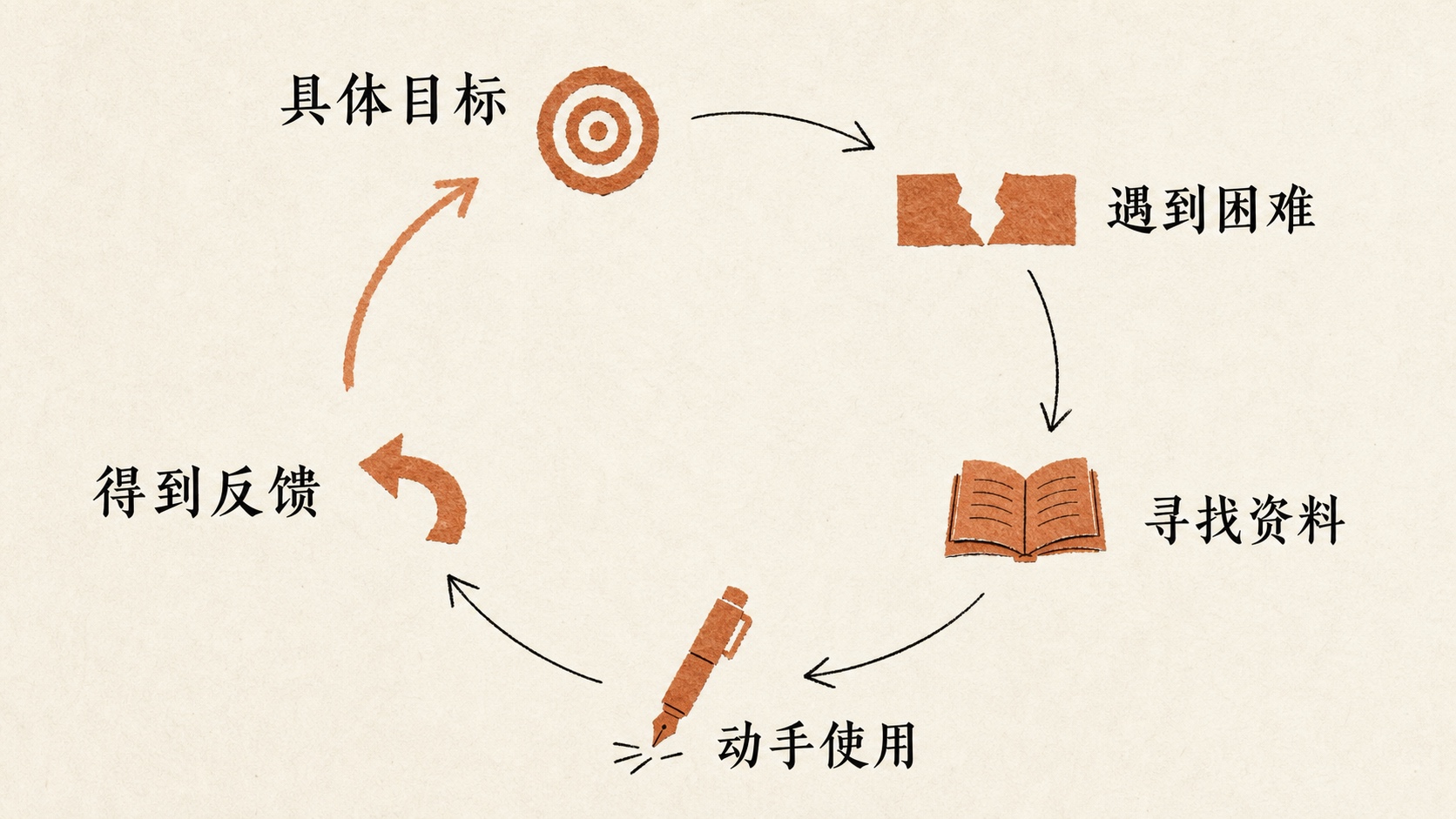
Looking up information at that point is different: whatever you find gets applied immediately. When there’s a real problem right in front of you, what to learn and where to fill the gaps becomes obvious. You test it right away, and you instantly know what’s off.
As the American Psychological Association notes on deliberate practice: practice requires clear goals and immediate feedback on where you went wrong. Mere repetition has limited value.
This also explains why things you look up on the fly often stick better than what you once painstakingly memorized. It solved an immediate problem, and you applied it right then and there. Next time a similar situation pops up, your brain recalls it far more readily.
So now when I learn something, I try to start with a concrete problem to solve. Without a specific problem, no matter how much material you consume, it dissolves within a couple of days, leaving behind only an ever-growing pile of notes.
Of course, you shouldn’t swing to the other extreme and assume every reading session has to yield an immediate payoff. Novels, history, poetry—they don’t necessarily have any immediate utility. They might take years to shape someone’s judgment, or simply make a person a little less coarse. If every page required a tangible deliverable, reading would just become another job.
When picking up a skill, learning with a problem in mind is usually faster. Reading casually out of pure curiosity the rest of the time is completely fine, too.
After Saving Notes, You Still Have to Put Them to Work
Dan Koe laid into the “second brain” pretty aggressively. But keep reading, and you’ll find he isn’t actually against using tools to take notes. He used Roam Research himself, created digital knowledge products, and was pitching a new vault tool right in that essay.
Which is pretty amusing: tearing down the second brain in the opening, then promoting a brand-new database tool by the end.
Tools are obviously useful. They help you store material, surface related items, and slowly accumulate scattered thoughts over time. When Andy Matuschak wrote about “evergreen notes,” he pointed out that writing a note is just the start—you have to keep revising it, cross-reference it with past notes, and ideally work it into new essays and projects. Just archiving it doesn’t cut it.
Saving a note into a database just means it isn’t lost yet. It only starts becoming useful when I rewrite it in a draft or use it to overturn an earlier judgment.
I used to obsess over how to capture faster, file more accurately, and search reliably. Now I care much more about one thing: once I save this, will I actually ever use it again?
I ask myself what this material will actually do next: Go into the draft I’m currently writing? Tweak a product spec? Compare it against an old idea? If I can’t answer that at all, then no matter how sleek the system is, it’s just helping me stack clutter more neatly.
So I’ve set a blunt rule for myself. Every time I save something that feels important, I force myself to write a single line: How does this relate to something I’m actively trying to solve right now? If I can’t write that one sentence, I don’t save it.
If it genuinely feels useful, I put it to work in whatever I’m doing as soon as possible. Even if it’s just weaving it into a paragraph or revising an assumption, that’s far more useful than filing it away by the book.
As for AI, I’m happy to let it search, categorize, flag where evidence is missing, or sketch out a few structural options. But what I actually believe is still something I have to articulate myself while writing.
Getting stuck halfway through a sentence usually shows me I never really understood it in the first place. It’s annoying, but getting stuck tells you exactly where your thinking falls short.
I Don’t Want to Remember Everything I Read Anymore
It’s impossible anyway, and it turns reading into just another exam. How much you retain from a book depends not only on technique, but on how much it connects to your life right now.
From now on, when I come across a great article, I’ll ask first: What can I actually do with this today? As for how to never forget it—that’s just not that important anymore.
If nothing comes to mind right away, that’s fine. Just read it and move on; there’s no need to cram everything into your bookmarks.
Most books will be forgotten sooner or later. But a single sentence from one might keep me from making a foolish choice next time, help me cut a line of fluff when writing, or give me a little more patience when someone else is stressed. Maybe that’s what truly stays with you.
By then, I won’t even remember which page it came from.
And that’s fine.
The book has already done its job.