Most people trading stocks haven't learned too little—they just can't use what they've learned.
Wyckoff, Livermore, value investing, hot money sentiment, fundamental plays—they’ve watched every course and taken every note. Sitting quietly during post-market reviews, everything makes sense. But the moment live trading begins, their mind goes completely blank. You understand every principle, yet you lose money on every real trade. Almost every trader who’s been through it knows the feeling.
The Biggest Gap Between Retail and Institutions Was Never Strategy—It’s Process

Everyday retail trading is completely fragmented: blindly scanning news before the open, making spur-of-the-moment intraday decisions, and jotting down careless post-market notes with zero progress to show for it. Institutions stay consistent not because of superior talent, but because they follow a fixed process: filtering opportunities pre-market, trading with discipline intraday, and rigorously correcting mistakes post-market. Quants go even further—they run entirely on data.
Scattered techniques will never beat a systematic set of rules.
Ask AI Directly If You Should Buy, and It’ll Just Tell You What You Want to Hear

In a rush to take a position, plenty of people ask AI point-blank: Can I buy this stock? The AI’s response is always well-organized and looks professional. Follow it a few times, and you end up losing money without a clue why.
It has no trading framework, no data verification, and no risk management logic. If you want to go long, it digs up a pile of bullish reasons; if you want to buy the dip, it downplays every risk. Every line sounds reasonable, but all it’s doing is amplifying your emotional trading.
The Two Fatal Flaws of Retail Traders: No Data, No Process
Plenty of people obsess over trading strategies to the point of delirium: studying trends today, sentiment tomorrow, and value the day after. All these methods pile up in their heads, tangled and contradictory, completely falling apart the moment the market moves against them. Beyond that, there are two fatal flaws that are the hardest to fix.
First, no reliable data sources. The pre-market news, bullish headlines, and thematic hype you scroll through are all stale, second-hand noise that the market has already digested. Institutions finished positioning long before you arrived; jumping in on the news simply means you’re holding the bag.
Second, no fixed execution process. Strategies are static, but people are alive—and emotional. Without hard rules to constrain you, even the best technique goes straight out the window the second impulse takes over intraday.
That’s why I built an open-source toolkit called trading-research. It doesn’t recommend stocks, and it doesn’t trade automatically. What it does is organize solid strategies from across the market, connect them with public data that anyone can access, and set up a complete workflow covering pre-market, intraday, and post-market routines.
Sixteen Strategies: First, Stop Them Fighting Each Other
Online material is too fragmented: a little trend-following here, some volume-price analysis there, a bit of value over there—conflicting with each other and completely disjointed.
I spent two and a half months iterating through over 50 versions up to v2.57. I integrated 16 strategies—including value investing (Huayuan narrative valuation), Livermore trend-following, Wyckoff volume-price, hot money sentiment, options Gamma, US supply chains, A-share short-term trading, and Hong Kong market frameworks—stripping away platitudes and mysticism to keep only hard, executable rules. The most crucial part was resolving strategy conflicts: without decoupling them, packing in more systems only makes them unusable.
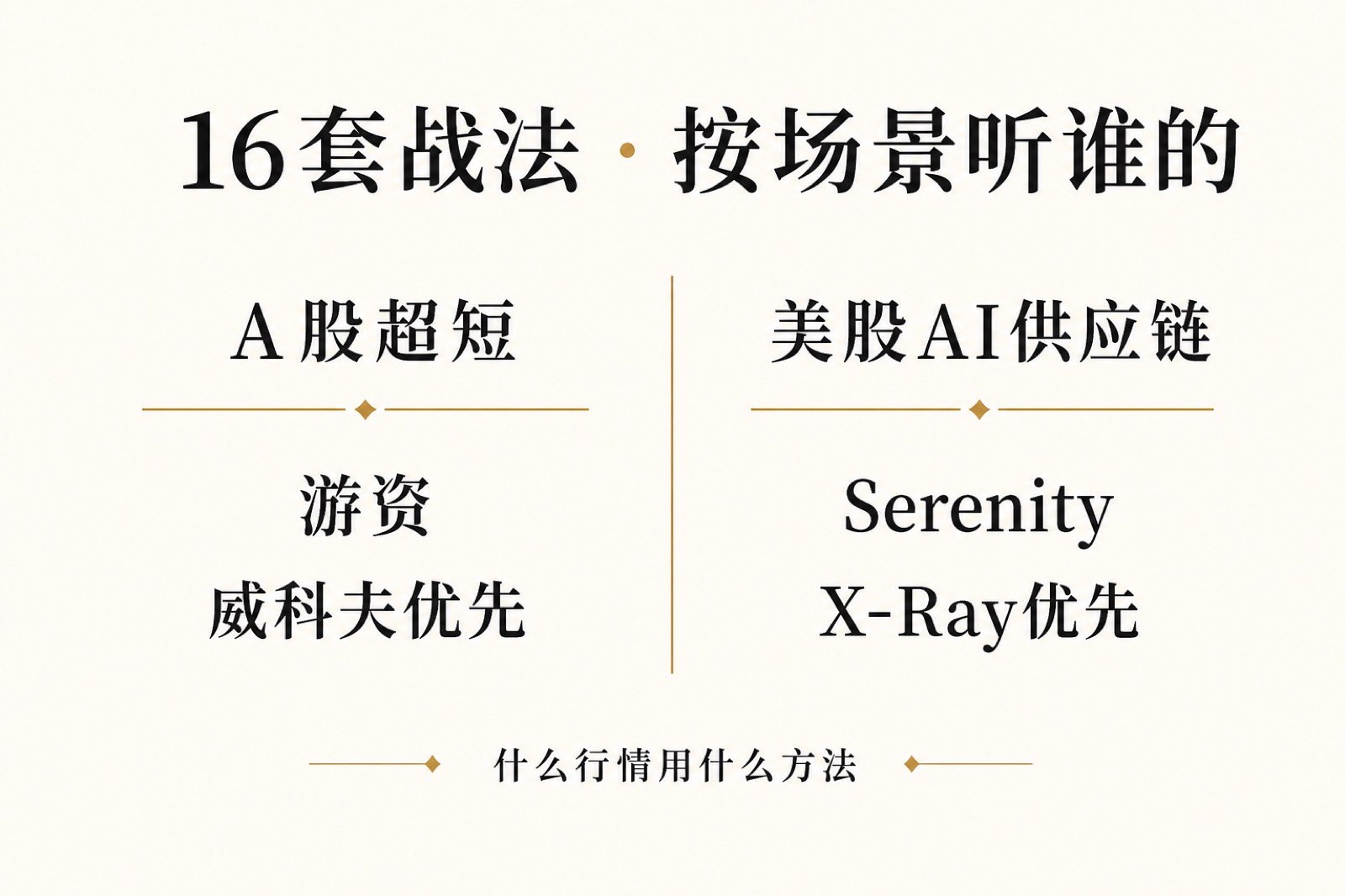
Many people lose money because they apply the wrong framework: using long-term logic for A-share ultra-short-term trading, or forcing short-term sentiment onto US equities. This tool matches scenarios and allocates weights accordingly. When trading A-share ultra-short term, it prioritizes hot money and volume-price logic while long-term frameworks automatically go silent; when trading the US AI supply chain, supply chain dynamics and risk control logic take precedence while short-term sentiment steps aside; when planning long-term positioning, it focuses on value and fundamental analysis, filtering out short-term noise.
The right method for the right market.
Pre-Market, Intraday, and Post-Market: Dedicated Handling for Each Stage
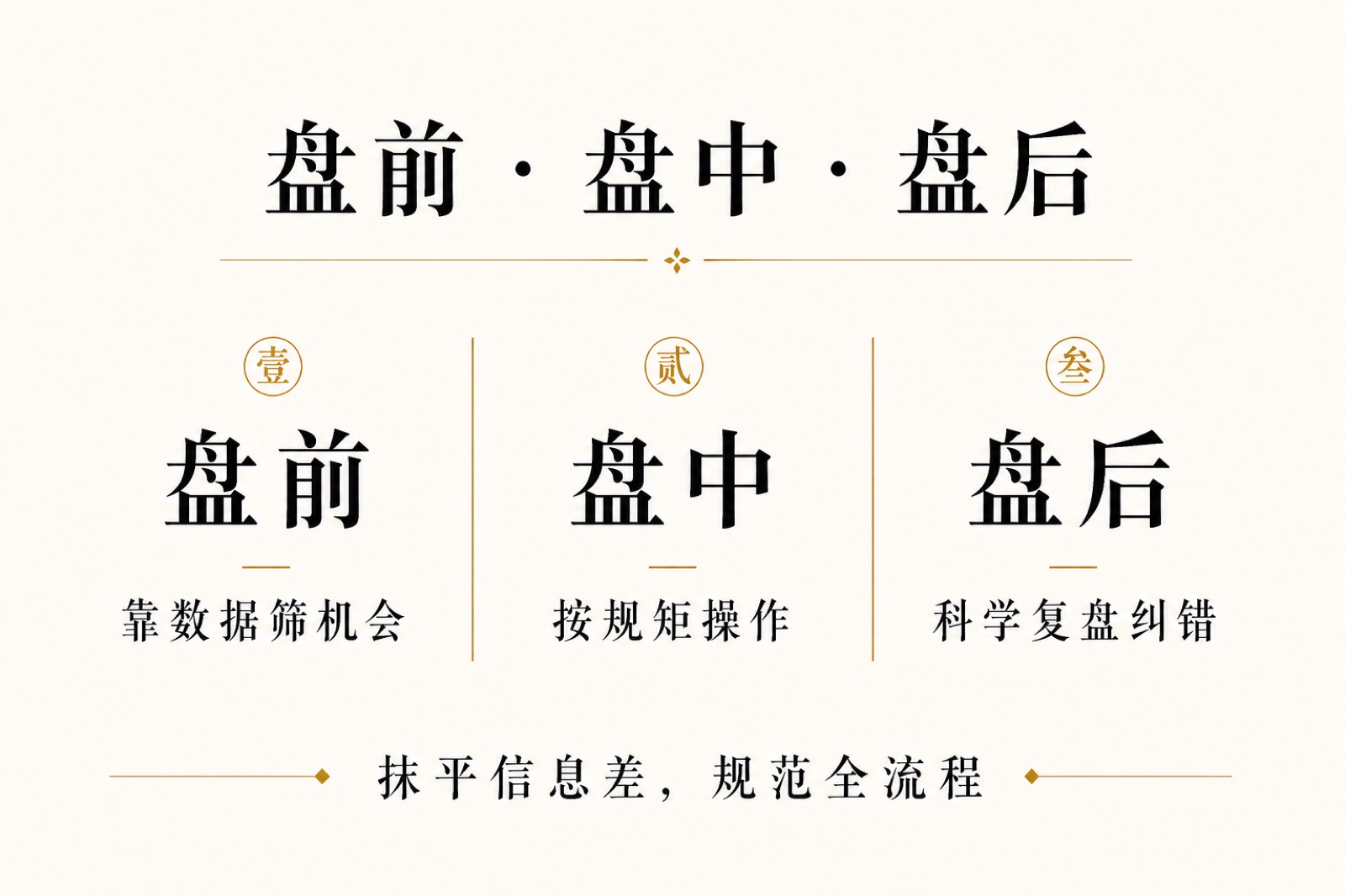
Pre-Market: Screen Opportunities with Data
Hooked up to authoritative public data sources across A-shares, Hong Kong stocks, and US markets. Original earnings reports, exchange filings, SEC disclosures, capital flows, options structures, sector sentiment, macroeconomic data—covering as much as possible. Pre-market is no longer about scrolling short videos or making blind guesses based on rumors; it’s about vetting risks and spotting opportunities with real data, narrowing the information gap with institutions right at the source.
Intraday: Execute by the Rules
Strategies are codified into rigid operational standards: entry conditions, position sizing, stop-loss levels, and exit plans when you’re wrong are all locked in ahead of time. Common pitfalls like making impulse intraday calls, chasing rallies, catching falling knives, and stubbornly holding losing positions are shut down by strict rules.
Post-Market: Review and Correct Mistakes
Comes with built-in decision tracking, hypothesis validation, and error post-mortems. Why did a trade win or lose? Where did the logic fail? How do you improve next time? Everything is documented and traceable, so you’re no longer scribbling a couple of careless review notes and walking into the exact same traps the next day.
It Answers a Few Concrete Questions
What are the specific opportunities and risks? Where are the operating boundaries right now? What conditions would prove my thesis wrong?
If there isn’t enough evidence, it won’t draw a conclusion; if data is missing, it flags it plainly. It doesn’t manufacture a false sense of security, and it doesn’t indulge impulsive trading.
How to Get Started
No complex commands, and no need to learn an entire technical stack first. Just hand it directly to your agent (Claude Code, Cursor, both work):
Help me install the skill at https://github.com/enzoyoyo/trading-research, mount it to my local skills directory according to the README, and run a self-check.
Most core features work right out of the box with no API keys or configuration required. For advanced multi-market feeds and official US market data, simply configure read-only credentials as needed. Everything is stored locally from start to finish—never commit them to your repository.
Boundaries
- No automated live trading; no broker order-execution APIs
- No stock picks, no price predictions, no guaranteed returns
- No win-rate figures, no get-rich-quick marketing
- Strictly focused on data aggregation, strategy execution, trading constraints, and post-market review support
It’s designed for anyone looking to break the habit of emotional trading and build their own complete trading framework. Strategies are just tools; only repeatable processes and strict discipline will hold up over time. If you have feedback after using it, feel free to open an issue in the repo.
Repository: https://github.com/enzoyoyo/trading-research
This article is for sharing trading insights and introducing investment research tooling only; it does not constitute any investment advice. No stock picks, no promised returns. The stock market carries risk—invest with caution. Make all trading decisions independently, and trade at your own risk.