
On the surface, the industry's widespread anxiety over large language models stems from compute being too expensive, applications failing to turn a profit, and productivity gains failing to materialize. But set against the broad sweep of business history, the truth is far more piercing: the very fact that everyone is constantly talking about "cutting costs and boosting efficiency" proves we haven't even finished the early phase of stage one. Throughout industrial history, the true maturation and explosion of any general-purpose technology has always been marked by "killing the efficiency narrative." From BlackBerry's pocket office to the smartphone's entertainment empire; from forty years trapped beneath steam line shafts to the imminent arrival of an Agent super-browser—drawing on the "industrial history perspective" of Professor Zeng, former Chief Strategy Officer at Alibaba, I have re-examined the underlying logic of this great technological migration.
1. The “BlackBerry Moment” of Efficiency: Why 99% of AI Narratives Miss the Point
Over the past two years, the tech and venture capital worlds have fallen into a collective bout of cognitive mania and exhaustion: foundational model vendors grind night and day burning compute, racing on reasoning, and gaming benchmark leaderboards, while application founders and enterprise clients are left deeply disoriented. The market is flooded with repackaged AI copy-polishers, code completions, and meeting-notes generators. It looks like a flourishing ecosystem, but user retention is miserable and willingness to pay is paper-thin. Traditional tech giants have equipped their employees with every conceivable "AI assistant," yet their income statements and total factor productivity show no qualitative leap whatsoever.
Why is this happening? Because today's commercial narrative around large language models is, in almost 99% of cases, chained to a single word: "efficiency."
Yet if you leaf back through the history of commercial technology, you will find a startling, widely overlooked law of history: whenever a general-purpose technology truly matures and explodes into mass adoption, people stop talking about efficiency altogether.
Wind the clock back twenty years to the eve of the mobile internet. Before the iPhone, the undisputed king of mobile devices was the physical-keyboard BlackBerry. What did the industry elites and tech media obsess over day in and day out? Nothing but "efficiency"—reading and answering corporate email on the go, approving business documents at the airport gate, checking calendars and contacts in the palm of your hand. In the eyes of every investor and analyst at the time, the entire point of the mobile internet was to build a "pocket office" that would double the productivity of business professionals.


Two answers to the same niche. On the left is the BlackBerry: a screen barely large enough to read an email, with a third of the body surrendered to a physical keyboard—it took "fast typing" to the extreme because it believed the purpose of mobility was work. On the right is the original 2007 iPhone, where the physical keyboard was swallowed whole by a glass touchscreen, identifiable as the first-generation model by its silver aluminum bezel and black plastic base. Derided at launch for being slow to type on and ill-suited for business, that very screen went on to house short-form video, mobile gaming, and live streaming. Keyboards serve efficiency; screens serve desire. The side that bet on efficiency lost the entire era. Left: BlackBerry 8900, photo by Beamish4, CC BY-SA 4.0. Right: Original iPhone, photo by Carl Berkeley, CC BY-SA 2.0. Both images are photographs of actual devices, not promotional materials; the right image shows an unlit screen, identified by the silver aluminum bezel, bottom black plastic cutout, and absence of a front-facing camera.
Yet once 3G and 4G networks blanketed the world, and multi-touch smartphones truly matured and penetrated every corner of the globe, who went around talking about "mobile working" every day? Everyone knew a smartphone could handle office tasks and send emails, but that had become an invisible, taken-for-granted utility, like running water. What were the super-apps that actually swallowed the lion's share of time for billions of people and propped up multi-trillion-dollar commercial empires?
They were TikTok (and Douyin), Honor of Kings and Genshin Impact, Instagram, YouTube, streaming video, and live broadcasts—all entertainment, all social interaction, all an outlet for psychological desire and lived experience!
Why can't the efficiency narrative sustain the endgame of a technology cycle? Because efficiency gains face hard physical constraints imposed by human biology and social organization, whereas the expansion of entertainment and desire knows no ceiling whatsoever.
Consider this: even if a super-AI tool arrived today that boosted a knowledge worker's efficiency by a flat 100x, could they actually accomplish 100 times more than before? Absolutely not. Because the responsibility an individual can bear, the decision-making risk they can digest, and the psychological load they can handle per unit of time are strictly limited. No one can sign off on 100 high-stakes business decisions involving tens of millions of dollars in a single day, nor can anyone shoulder ultimate accountability for the success or failure of 100 projects in 24 hours. If society simply makes slide deck creation 100 times faster, the net result will merely be 100 times more garbage slide decks that nobody reads, sending marginal utility cratering to zero.
Turn your gaze to entertainment and psychological consumption, however, and the ceiling vanishes in an instant.
Twenty years ago, in the early days of the PC internet, spending more than 10 hours a day online was branded by mainstream society as "severe internet addiction," even spawning Yang Yongxin-style electroconvulsive therapies. Today, outside of 8 hours of sleep, almost every modern person spends 16 hours continuously online—scrolling short clips, playing games, watching streams, and interacting on social media. The digital realm has seamlessly blended into the background environment of human existence, and nobody bothers arguing anymore whether this qualifies as an "addiction."
Human civilization's underlying impulse has never been to work for work's sake. The ultimate purpose of technological efficiency gains is to ransom humanity from grinding mechanical labor, freeing up more time to splurge on entertainment, experience, and emotional sustenance.
Look back at today's LLM ecosystem: when the entire industry is still patting itself on the back because "code generation rates improved by 30%" or "document summarization was shaved down by 5 minutes," it proves we are still mired in the AI era's "BlackBerry Moment." The so-called "productivity" displayed by large models today is nothing more than a temporary mask borrowed from the old industrial world, before this frontier technology has found its native soul and true host. We have not even cleared the early days of stage one.
2. Why the Application Explosion Cannot Be Rushed
If today's frenzy is merely the opening moments of the cycle, where exactly are we standing? In a recent interview, Professor Zeng, former Chief Strategy Officer at Alibaba, proposed an analytical lens that cuts through the cyclical fog: an "industrial history perspective."
Professor Zeng divides the evolution of a general-purpose technology (GPT) into three rigorous stages: Stage 1 is infrastructure rollout; Stage 2 is the explosive boom of applications; and Stage 3 is the native era, where business paradigms and organizational structures are completely remade by the new technology.
In the podcast, electricity's development was drawn as an analogy for AI: "In 1892, Edison invented the light bulb, lighting up that one-square-kilometer patch of Manhattan... and then around 1910 there was a substantial breakthrough... roughly when the power grid covered major American cities, and finally that year saw two major applications emerge... the washing machine and the refrigerator."
Edison publicly demonstrated his carbon-filament incandescent lamp at Menlo Park in 1879; the day human civilization switched on its first central DC power distribution network, illuminating Manhattan's financial district with the commissioning of the Pearl Street Station, was September 4, 1882. The year 1892 mentioned in the interview was actually when J.P. Morgan orchestrated the merger of Edison General Electric with Thomson-Houston, formally giving birth to General Electric (GE).
Correcting these spoken historical inaccuracies is by no means nitpicking, because the actual history makes Professor Zeng's thesis even more profound and striking:
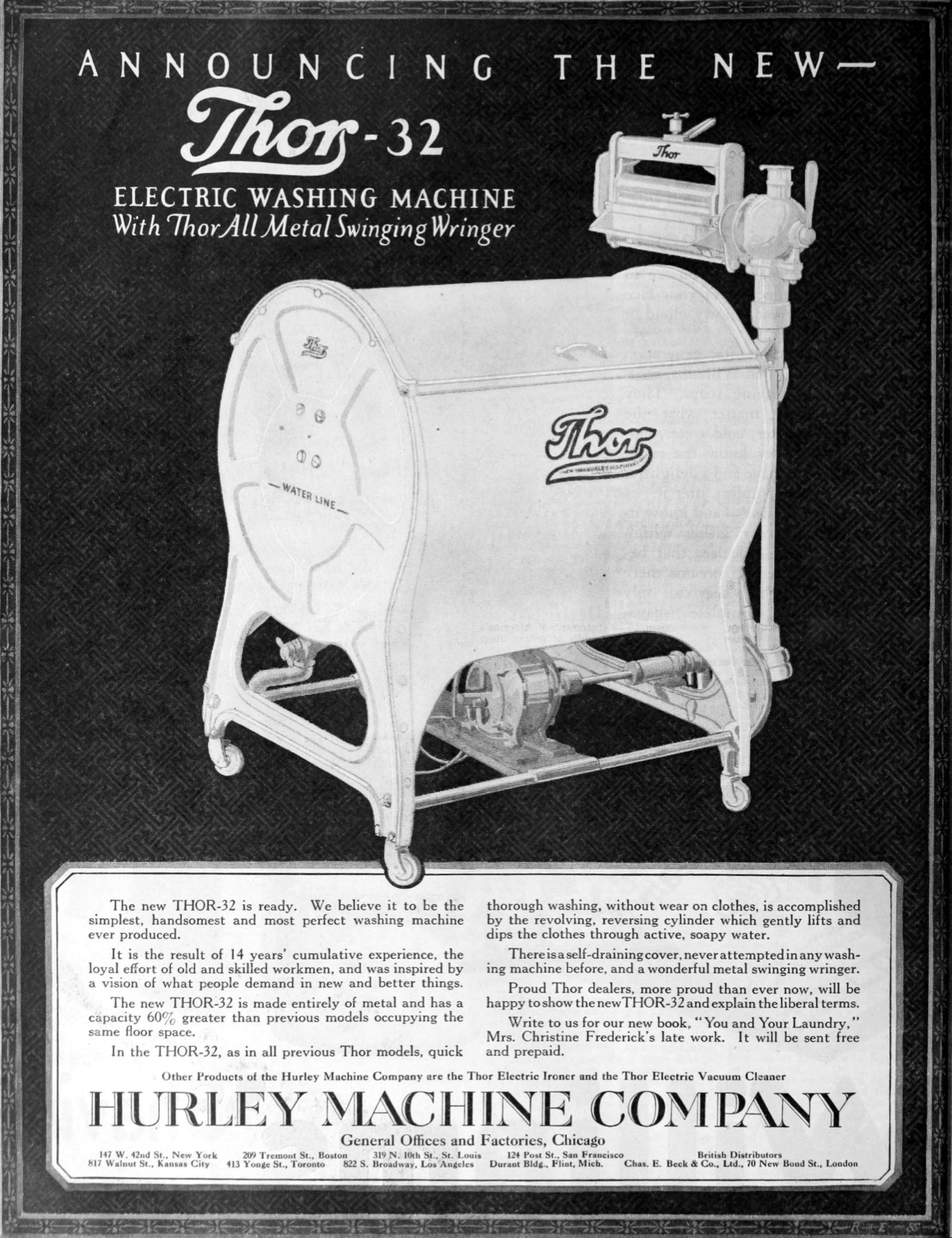
From the moment the first commercial power station began supplying electricity in 1882 to the launch of the first commercially sold electric washing machine, the Thor (1908, though built in 1907), humanity endured a grueling 26-year trek. The timeline for other killer appliances that truly entered millions of households and reshaped how humans live and entertain themselves is even more staggering:
- Commercial Radio Broadcasting (KDKA): Emerged in 1920, a full 38 years after the first power station went online. It was the spread of radio that brought music, ballgame commentary, and soap operas into living rooms in real time for the first time, inaugurating the modern entertainment industry;
- Residential Room Air Conditioners: Carrier invented industrial dehumidification air conditioning in 1902, but the first standalone room air conditioner designed for standard residential bedrooms did not arrive until 1931—a gap of 49 years;
- Commercial Black-and-White Television: The US FCC did not officially grant commercial television licenses until 1941, a staggering 59 years after Edison threw the switch at Pearl Street.


The way electricity truly penetrated households was not by saving on power bills, but by capturing the evening. On the left is a promotional photo from radio's early years: three figures kneeling on a rug, turning the tuning knob, with the "morning glory" horn flared open toward them (the flare's top was cropped out in the original negative)—notice their posture, mirroring how humans once gathered around a campfire. On the right, circa 1958, a father crouches before the TV to change channels, four children sprawl across the floor, and the mother reads a comic version by the sofa—the television sits more central than the fireplace. More than thirty years separate the two photographs, yet living room furniture was being rearranged in the exact same direction: not toward greater efficiency, but toward a screen. Left: Photo by Bain News Service, mid-1920s, Library of Congress, public domain. Right: Photo by Evert F. Baumgardner, circa 1958, US National Archives, public domain. Both are genuine period photographs, though staged promotional/documentary shots rather than candid captures.
Across this timescale, an intriguing phenomenon emerges: the adoption path of electricity also perfectly validates the great migration from an "early efficiency narrative" to a "mature entertainment empire!" Factories initially hooked up to electricity so textile workers could spin cloth through the night, so mines could be illuminated, and so electric streetcars could run (pure productive efficiency). But what truly transformed electricity into the indispensable lifeblood of modern civilization, and what consumed vast shares of American disposable income, were Hollywood film projectors, radios broadcasting around the clock, home televisions that emptied the streets every evening, and the dazzling rollercoasters of Disneyland!
3. “Application-Specific Knowledge” Hard-Won Through Trial and Error Is Technology’s True Compass
Confronted with the half-century timeline of the electrical revolution, many instinctively counter: "The industrial era required mining coal, pouring concrete, and laying copper wire—heavy physical assets. Today is made of digital bits, software distribution takes seconds, and AI can't possibly take that long."
This objection sees only the "laying of pipes" while ignoring the "exploration of human nature." Shipping code may take a single second, but the trial-and-error feedback loop of figuring out what humans actually want cannot be compressed by any amount of compute.
Stage 2 (the application explosion) is by no means an inconsequential warm-up lap. Without the chaotic, short-lived, and often sacrificial trial-and-error of Stage 2, underlying technology would have no clue where to erect the native edifice of Stage 3.
Foundational technology has no eyes of its own; "application-specific knowledge," forged through trial and error at the application layer, is the only compass capable of guiding technology's evolution.
Look back at ByteDance during the mobile internet era: when Zhang Yiming founded the company in 2012, he had not foreseen the short-video empire that would rule the world five years later. In its first few years, the ByteDance team pumped out over a dozen seemingly trivial, lowbrow utility and meme communities—Neihan Duanzi, Gaoxiao Jiongtu, Neihan Manhua, and Jinri Toutiao. It was precisely through these tens of thousands of points of friction with real users that ByteDance's industrial-scale engineering stumbled upon and perfected its master key: mobile recommendation algorithms and feedback loops. Around 2016, when 4G data rates plummeted, smartphone cameras and processors received massive upgrades, and the short-video wave surged forward, ByteDance seamlessly fused its battle-tested recommendation algorithms with short video, giving birth to the global phenomena of Douyin and TikTok.
Could Douyin or TikTok have been invented in 2012? Impossible. Even if you had handed that 2012 team ten thousand of the latest GPUs, without the nourishment of Toutiao's massive text-and-image dataset, and without thousands of encounters touching the grassroots entertainment psychology of everyday people, no one could have conjured that vertical-swiping black hole out of thin air.
This is the reality the AI industry must face today: the thousands of seemingly mindless AI chat interfaces, crude anime image generators, and companion toys scoffed at by mainstream elites are not worthless venture bubbles—they are the "cognitive R&D cost" the industry must pay for the next generation of truly great native applications. Technology cannot skip the graveyard of Stage 2 to leap straight into the promised land of Stage 3.
4. The “Browser”: Protocols and Super-Gateways in the Agent Era
"Right now, there isn't even an embryonic Yahoo in sight. That's why I say we haven't even seen the browser yet. In other words, we are still waiting for a browser to emerge."
I suspect many people's immediate reaction is to take this literally: does it mean building a "new browser" packed with AI plugins for our phones and laptops? Or creating an Agent directory or app store?
That is an exceedingly superficial misreading of business history.
What was the true historical achievement when Marc Andreessen and his team developed NCSA Mosaic and the Netscape Navigator? Before the browser, the internet was an academic archipelago rife with arcane command-line utilities (FTP, Gopher, Telnet, Usenet), navigable only by the few geeks who understood how to configure IP addresses and ports to exchange data. The genius of the browser was that it defined a unified rendering engine and hyperlinking standard (HTML/HTTP), abstracting the entire complex network topology beneath a pane of glass that any ordinary person could navigate with the click of a finger. The browser served as the universal protocol and runtime environment of the Web era.
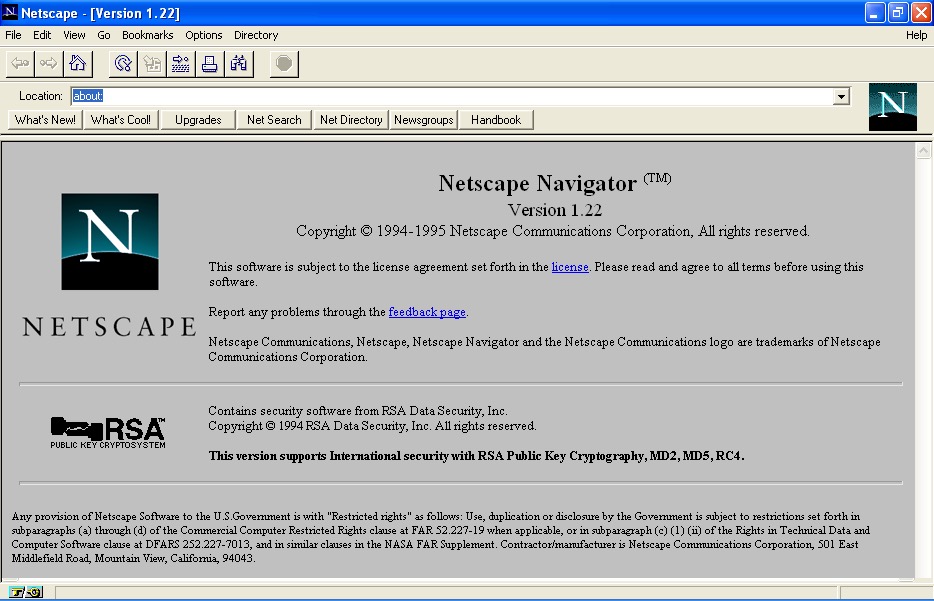
The "browser" we are clamoring for today is, in essence, the universal interaction protocol and master gateway of the Agent era.
Examine today's AI agent ecosystem: it almost perfectly recreates the chaos and fragmentation on the eve of the browser's birth in 1993. OpenAI pushes its own GPTs and Assistants API; Anthropic pushes Claude Projects and Computer Use; open-source frameworks build their own walled gardens and reinvent wheels. Every agent is an isolated island, incapable of communicating with others, invoking capabilities across boundaries, or sharing memory and context. Meanwhile, everyday users are frightened off by code repositories that demand API key configurations and complex local environments.
This "super-gateway and communication protocol of the Agent era" represents the most critical and lucrative ecological throne in the entire history of AI. Its arrival will definitively end the chaotic era of model balkanization.
Yet there is a deeper dimension to consider: the commercial essence of this super-gateway for the Agent era can never be a lightweight "yellow pages directory"; it must be a heavy-duty "trust and asset settlement layer."
Why? Because web pages in the Web 1.0 era were "read-only and weakly interactive." Back then, if you clicked the wrong link in Yahoo's directory, the worst outcome was closing the tab and wasting two minutes of your life. The cost of error was virtually zero.
Agents are a completely different beast: "How do you know which agent actually works? Would you dare hand a critical task over to an agent? Would you trust an agent with your wallet? Would you trust an agent with your personal privacy? Where does that trust come from? And how do I know the fees it charges me are legitimate?"
Follow these questions to their logical conclusion, and the reality hits hard: the moment agents can invoke tools to book hotels, execute contracts, and manipulate financial accounts, prompt injection, unauthorized API calls, and hallucinated executions cease to be technical talking points and become direct losses on the balance sheet. When that happens, there is only one question that truly matters: who picks up the tab?
The cost of an agent's mistakes is catastrophic property, legal, and reputational disaster.
Therefore, the core competitive advantage of the future "browser" that commands the landscape will not be boasting that "we connect to 100,000 agents." It will be its ability to provide sandboxed security isolation, fine-grained permission controls, cross-agent reputation verification, and financial-grade underwriting with upfront breach indemnification. Its role will be a trinity: the graphical shell of an OS, the Visa/Mastercard of the modern financial system, and the Swiss Re of liability insurance. Whoever solves the trust dilemma so humans can comfortably turn their backs to an agent will hold the key to the next multi-trillion-dollar commercial empire.
5. Big Tech’s “Genetic Self-Destruction”: Why Old Species Never Cross Technological Cycles
As such a future-defining super-niche emerges, a pressing question arises: can today's tech giants (Microsoft, Google, Meta, Amazon, Alibaba, Tencent)—swimming in capital, hoarding the world's top compute and talent—leverage their immense resources to incubate this new species directly?
For Big Tech to cross this cycle through internal spin-outs is, in terms of commercial genetics, a direct violation of the laws of nature.
Looking back over thirty years of business history, the undisputed rulers of Stage 1 almost universally faced catastrophic destruction once Stage 3 arrived:
- AOL (America Online): The uncontested ruler of the dial-up era, commanding a market capitalization of $222 billion in 1999. After the rise of broadband and the open web, it was sold off for scrap to Verizon in 2015 for $4.4 billion—a 98% destruction of wealth;
- Yahoo: Defined the portal and directory era of Stage 1 of the internet, with a market cap topping $125 billion in early 2000. It stumbled at every turn as algorithmic search and social networks took over, until its core assets were similarly absorbed by Verizon in 2017 for $4.83 billion;
- BlackBerry (RIM): The uncrowned king of feature phones and physical-keyboard mobile productivity, reaching a market cap of $80 billion in 2008. In the face of the multi-touch and mobile entertainment tsunami unleashed by the iPhone, its hardware DNA rapidly pushed it to irrelevance.
Why do the giants closest to the future, sitting on the largest cash reserves, so often become the most tragic dinosaurs at the turning point of a cycle?
The root cause does not lie in executive IQ or work ethic. It lies in the fact that the organizational structures and product forms of Big Tech are themselves fossils of the previous PC and mobile eras, carrying an irreconcilable "genetic rejection mechanism" within:
- The Matricidal Business Model Dilemma: A corporation's lifeblood is determined by its current core cash cow. Google's hundreds of billions in annual profits are built on users typing keywords and clicking on ten sponsored blue links; e-commerce giants' hundreds of billions in profits are built on the "traffic tax" merchants bid for shelf exposure. Yet the ultimate mission of a genuinely native Agent gateway is to kill the search box, kill the digital shelf, and eradicate all redundant informational friction in between, fulfilling user intent directly. Asking Big Tech to pour all its energy into developing a product that shatters 90% of its existing revenue stream at the root is like asking someone to slash their own carotid artery just to master an ultimate martial art;
- The Bureaucratic Immune Backlash: Big Tech is riddled with rigid job ladders, quarterly OKRs/KPIs, convoluted reporting structures, and delicate balances of departmental self-interest. The moment any truly disruptive innovation shows the slightest sign of cannibalizing legacy profits or threatening layoffs in established units, veteran departments deploy a thousand unassailable bureaucratic excuses—compliance reviews, legal risks, ROI calculations—to quietly smother it in the crib. Kodak invented the digital camera first, only to shelve it to protect film profits; Nokia built a cutting-edge touch-tablet prototype, only to cling to Symbian's departmental fiefdom;
- The Clash of Talent and Cultural DNA: Companies building foundational models in Stage 1 revere scientists who publish top-tier academic papers and systems engineers who tune multi-thousand-GPU clusters. In contrast, teams building native applications and brand-new gateways in Stages 2 and 3 require "product obsessives" and growth hackers who are exquisitely attuned to subtle human emotions and capable of tapping into mass-market psychological cravings. These two groups are fundamentally incompatible in their values, aesthetic tastes, and decision-making cadences. Putting a cohort of researchers pursuing academic purity in the same room with product managers obsessed with making users addicted generates enough organizational friction to paralyze the entire company.
Consequently, the giants can use their formidable balance sheets to retreat behind the scenes and provide compute utilities (which remains a colossal business). But the next generation of super-applications and ecological gateways that define the future are destined to emerge outside the establishment, growing wild across the frontier, forged by new teams unburdened by legacy baggage.
6. The Dynamo Paradox: Hanging Motors on Old Line Shafts Will Never Yield Productivity
If the preceding insights speak to macro strategy, another observation points squarely at the organization itself: organization and strategy are two sides of the same coin; before you talk strategy, you must talk organization.
"Before discussing strategy, you must discuss organization. Organization has become far more important for the CEO." The two are "the yin and yang, impossible to separate entirely"—both are expressions grown from the exact same new DNA.
This seemingly counterintuitive argument rests on a famous theoretical cornerstone in modern economic history: the renowned "Paul A. David Dynamo Paradox" (Paul A. David, 1990).
Nobel laureate Robert Solow famously quipped: "You can see the computer age everywhere but in the productivity statistics." Seeking to unravel this puzzle, Stanford economic historian Paul A. David spent years combing through nearly half a century of historical archives on American industrial electrification.
He uncovered a startling historical fact: Edison built his Pearl Street Station in 1882, but it was not until the 1920s—a full forty years later—that electricity produced a steep upward surge on America's industrial productivity curve. Throughout those four decades, US industrial productivity barely budged.
What was the reason? The answer was suspended right from the ceilings of those old factories: the heavy iron line shaft.
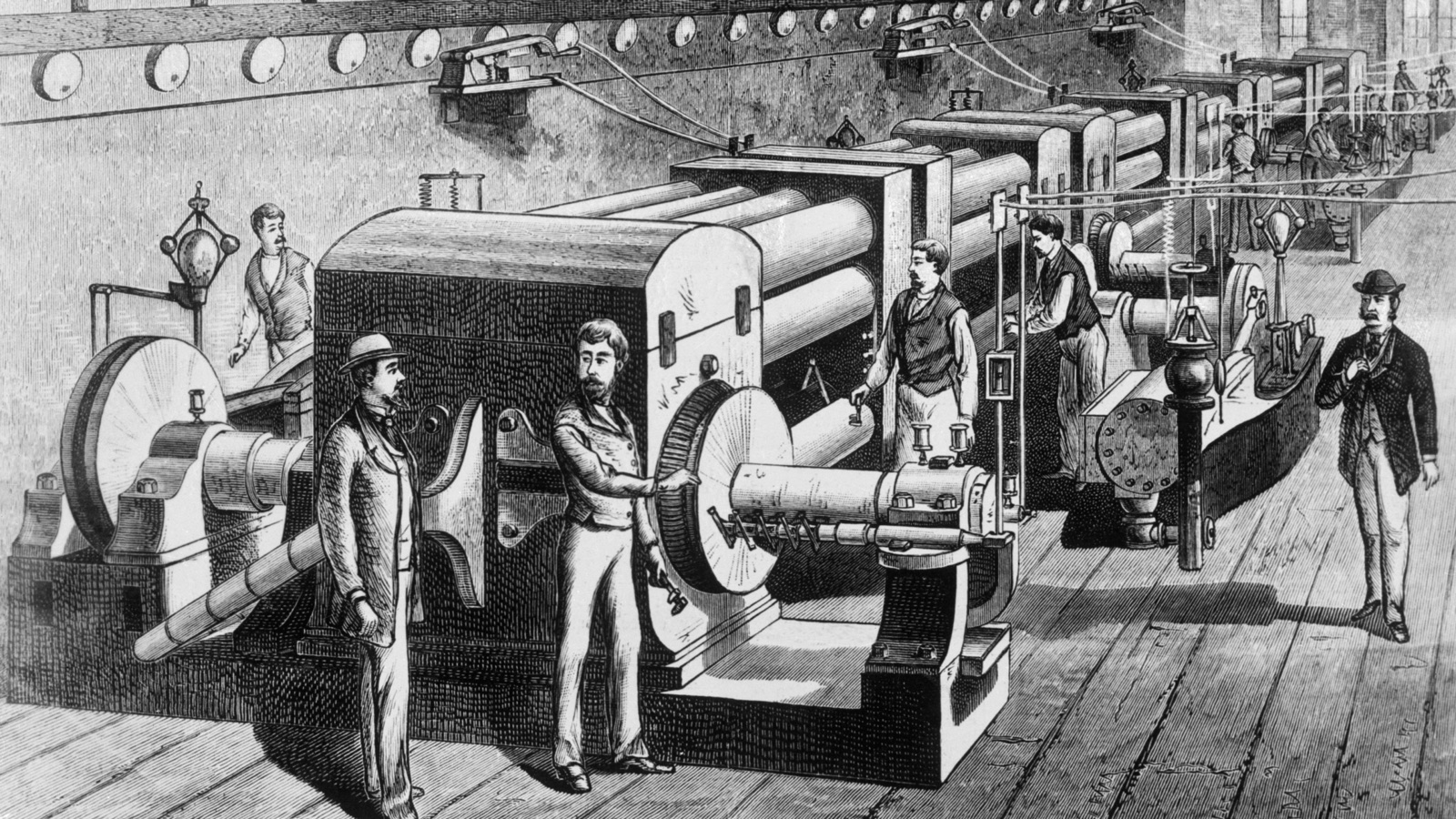
In the 19th-century steam age, a factory could only afford a single, cumbersome central steam engine. To continuously transmit power from that engine to hundreds of lathes and stamping presses across the plant, a crisscrossing transmission system of cast-iron shafts, gears, and spinning leather belts had to be mounted across the ceilings—the so-called "line shaft." Because every machine had to be physically coupled to the line shaft to operate, the factory's physical layout was subjected to brutal constraints: machines had to be arranged in rigid parallel rows hugging the shafts; factories had to be built as narrow multi-story buildings so power could be transferred vertically; daylight was obstructed, belts spun at breakneck speeds, noise was deafening, and hauling materials between floors was convoluted and wildly inefficient.

During the first thirty years of electrification, what the vast majority of clever, conservative factory owners did was simply dismantle the steam engine, bolt a large electric motor into its spot, and continue driving the same creaking overhead line shafts and belts! The power source was cleaner, but the factory's physical layout, machinery placement, and workers' assembly workflows remained unchanged down to the millimeter. This sort of patch-up "improvement" yielded negligible efficiency gains.
The real productivity miracle occurred the moment an entirely new species arrived, such as Ford's Highland Park Plant: Henry Ford and his team tore down every last line shaft and drive belt from the ceilings! Exploiting the distributed nature of electricity, they fitted every single lathe and stamping press with its own dedicated fractional motor. Liberated from the location of central power, factories were flattened into sprawling, single-story complexes; equipment was arranged unidirectionally, strictly following the sequential manufacturing process of automotive parts. Thus was born the world's first modern moving assembly line, and the production time for a Model T plummeted from 12 hours to just 93 minutes!
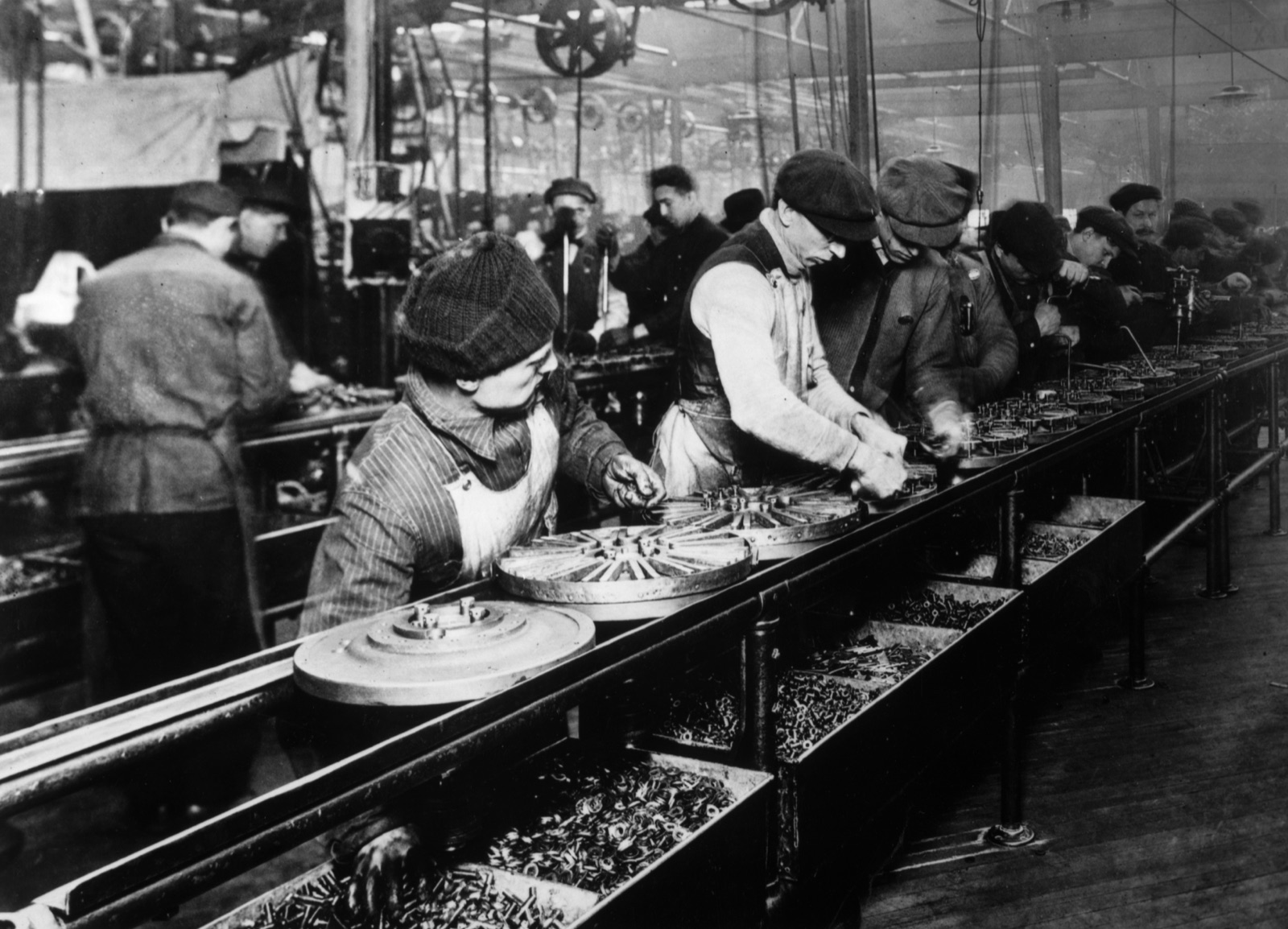
The technology was already there; the return was waiting on reorganization.
The time constant of organizational inertia is far longer than that of technological diffusion.
Hold this mirror of industrial history up to the present day, and you will find that the absurd behavior of most enterprises precisely mirrors the tragedy of a century ago: today, 90% of companies plugging in LLMs and rolling out Copilots are doing nothing more than hanging a new motor on an old line shaft!
Corporate organizational charts still follow the hierarchical reporting trees of the industrial age; departmental silos remain impenetrable; performance review cycles and bureaucratic sign-offs stay locked in stone. All they have done is issue a ChatGPT account to every workstation, or embed an AI sidebar in their clunky legacy internal software. An employee might churn out a report draft in one second with AI, but their manager still spends half an hour reviewing it. Workflows have not shortened by a single step, and boundaries of accountability have not been reimagined. This sort of superficial "digital embellishment" will never produce a fundamental leap in productivity.
In the industrial age, the "job title" is that ubiquitous line shaft!
The industrial age locked individuals into rigid job titles like "customer service rep," "finance supervisor," and "operations manager" because transmitting information was extraordinarily expensive. Division by job title was necessary to define who sees what data, who reports to whom, and who oversees which section of the assembly line. A job title is a mechanized, artificial barrier erected around scarce human cognitive capacity.
Yet in a future where intelligence is ubiquitous, hierarchical structures organized around job titles have become a noose choking efficiency. In a truly disruptive, AI-native organization, the atomic unit is no longer the "job title," but the "task." Future organizational architectures will be highly fluid: when a new business objective emerges, the system dynamically orchestrates two or three core human experts alongside dozens of silicon-based agents with specialized skills, self-assembling into an agile task swarm based on context. Once the task is completed, the swarm immediately disbands, feeding accrued data back into the global memory bank. Unless you smash the rusty line shaft of "job titles" dangling from the ceiling of modern enterprise, a true AI productivity explosion will remain pure fantasy.
7. Black Hole Effect vs. Price Wars: A Capability Moat Is Not a Profit Moat
The conversation featured two judgments regarding the competitive landscape of foundational LLMs. Both are deeply insightful in their respective contexts, but when placed side-by-side on the same logical table, they reveal a massive theoretical tension:
Proposition 1 (Compounding Intelligence and the Black Hole Effect): Leading frontier model labs have begun using their most capable models to generate high-quality synthetic data, correct errors, and train the next generation of models, creating an "AI training AI" compounding flywheel. Professor Zeng argues that this widens the gulf between the leader and everyone else, generating an absolute gravitational pull akin to a cosmic black hole that irreversibly accelerates the inward drain of top talent and capital.
Proposition 2 (Homogenized Oligopolies of Public Infrastructure): Professor Zeng then points out that as foundational models become public infrastructure, their ultimate commercial model will inevitably be "an oligopoly under heavy government regulation." And the defining trait of oligopolistic competition is "extreme commoditization"—products can be swapped out by downstream customers at will, forcing players to subsist on wafer-thin margins driven by minor differentiators, with any expectation of windfall profits gone.
If the black hole effect holds true and the leader possesses an uncatchable self-evolutionary flywheel, the endgame should be a "winner-take-all" cosmic singularity, leaving no room for a stalemate among competing oligopolists. Conversely, if the ultimate outcome is a commoditized public utility where downstream customers swap vendors at will, it proves the black hole's gravity has a ceiling and the frontrunner's technical moat is nowhere near as insurmountable as imagined.
The master key to untangling this contradiction lies in separating two concepts routinely conflated in business: an "absolute technical capability moat" versus a "genuine commercial pricing power moat."
The black hole effect acts upon the "absolute ceiling of capability," while commoditized competition acts upon the "pricing power of commercial profits." Not only is there no guaranteed positive conversion between the two, they are often brutally decoupled.
A frontier lab may pull three strides ahead of its rivals in arcane mathematical proofs, theoretical physics reasoning, and ultra-long logic chains, but what determines whether downstream enterprise customers open their wallets is never whether the frontrunner scored a 99; it is how close the runner-up is to the customer's everyday "good-enough line"!
For more than 85% of real-world commercial scenarios—pre-sales support, reporting spreadsheets, junior-level coding, contract review, copywriting—an open-source or second-tier model scoring an 85 clears the threshold of daily commercial viability. Once the runner-up crosses that bar, downstream customers will never pay a 10x token premium over the long haul for those extra 14 points of brilliance, even if the top model is smart as Einstein. The outsized technical profits that the frontrunner burned astronomical compute to manufacture will instantly collapse down to the industry's "marginal cost of inference" in a brutal price war.
In this era, a lead in raw algorithmic and model capability may last only a few months. Betting your commercial moat on a "generational technology lead" is fragile in the extreme; true moats can only ever be built on deep domain integration that code cannot replicate, proprietary data flywheels, and punishing organizational switching costs.
8. Will the Corporation Really Go Extinct?
In this envisioned future of organizations, collaborative entities "will certainly not be called companies," evolving instead into nimble, boutique, all-partner New Labs where human experts collaborate intimately with digital workers.
We must draw a sober distinction between what is destined to die and what can never disappear.
Over a century of industrial civilization, large corporations supported bloated cadres of middle management fundamentally because the information bandwidth of the human brain is limited. Executive orders had to be relayed down layer by layer through directors and managers, while front-line reports had to be aggregated upward through the same tiers. Middle management was, in essence, a physical amplifier and filter for information. But when multimodal agents can surface enterprise-wide operational context, financial data, and customer feedback in real time before everyone's eyes, traditional middle-management roles dedicated to supervising, relaying messages, and compiling formatted reports will lose all economic justification.
Yet the "corporation," as the greatest institutional invention of modern commercial civilization, will never disappear as a legal entity. None of the three pillars sustaining the modern corporate institution can be replaced by current AI technology:
- The Irreplaceability of the Legal Subject of Liability: When an autonomous agent defaults on tens of millions in commercial trade payables or causes a catastrophic failure in an automated medical setup, to whom does the court issue a subpoena? An algorithm cannot be sent to prison, and a task pipeline cannot serve as the debtor in an enforcement proceeding. The civil and commercial legal order of modern society must trace liability back to a recognized legal person endowed with civil capacity;
- "Limited Liability" as the Ultimate Shield for Human Exploration: Over the past three hundred years, humanity dared to shoulder immense risks—charting oceanic trade routes, laying railways, and building semiconductors—primarily because of the institutional protection of "limited liability." It allows founders and shareholders to cap their downside at their invested capital; even if the venture fails completely, debt will not wipe out their families or burden generations to come. If we were truly to regress to classical partnerships where partners bear unlimited joint and several liability, no one in an AI era rife with sudden technological disruptions would dare shoulder the ruinous risks of capital-heavy innovation;
- The Trust Anchor of Commercial Contracts: Multinational procurement teams and large enterprise clients trust you with their core lifelines because of your business license, paid-in capital, third-party compliance audits, and long-standing commercial reputation. No serious enterprise will sign a life-or-death contract with a stream of virtual code floating across the internet.
Reality provides the clearest proof: OpenAI and Anthropic, operating on the global frontier today, may run extremely flat and lean internal operations, but both have encased themselves within corporate entities incorporated in Delaware—OpenAI's for-profit arm has converted into a Delaware Public Benefit Corporation (PBC), and Anthropic is likewise a PBC. What is crumbling to dust is the "bureaucratic management regime" of the industrial era; what remains indestructible is the "legal liability bedrock" of the market economy.
9. Endgame Deductions for the Future
Synthesizing this historical depth, theoretical analysis, and real-world tension, and stepping away from short-term noise, I have deduced five high-conviction directional theses for commercial execution over the next three to five years:
1. The Next Trillion-Dollar Application Will Not Come from Efficiency Tools, but Will Explode in "Native Entertainment and Psychological Consumption"
From radio and television in the electrical revolution to TikTok and gaming in the mobile internet era, every technological wave reaches mass maturity only when it *kills the efficiency narrative*.
Current attempts to use AI for writing code, polishing slide decks, and refining weekly status reports are merely transitional relics akin to BlackBerry's "pocket office." Efficiency gains run up against a physical ceiling, but human desire, emotional resonance, and immersive experiences have no bounds. The next super-species born of the AI era will harness emergent model capabilities and multimodal interaction to flourish in virtual companionship, high-agency interactive storytelling, adaptive gaming, and entirely new forms of entertainment.
2. The Super-Niche of the Agent Era Is "Unified Protocols + Trust Guarantees," Not Shallow Directories
What Professor Zeng means by "waiting for a browser" is a unified runtime environment and interaction protocol capable of ending today's fragmented agent balkanization. But the core moat of this gateway will not lie in how many features it lists; it will lie in whether it can underwrite unauthorized agent actions and property risks. Players that become OS-level gateways in the future will inevitably operate as both graphical control hubs and credit-settlement institutions.
3. Big Tech Will Defend Compute Utilities, but Is Destined to Lose Dominance over Next-Gen Consumer Gateways
Giants like Microsoft, Amazon, Google, and Alibaba possess unmatched capital expenditure budgets and data center assets, making their transition into the "compute waterworks" of the AI era completely natural. Yet in the battle for the super-native gateway closest to the consumer, their legacy cash cows—search advertising, take rates on digital shelves, platform revenue cuts—will prove to be their most lethal curse. Disruptive gateways must burst out from the periphery, propelled by rogue upstarts free from legacy baggage.
4. The Real Battleground for Enterprises Is "Flattening Organizational Line Shafts," Not "Which Model You Bought"
Revisiting Paul A. David's dynamo paradox, every manager must wake up to this truth: paying for model API access is merely window dressing—hanging a motor on an old line shaft. What will truly separate enterprise winners from losers in the future is not who accesses the newest model release, but who dares to smash the bureaucratic silos built around "job titles" first, reorganizing operations into an agile, task-driven collaborative network. The dividends of organizational re-engineering will dwarf any pure technology stack selection.
5. The Radical Revaluation of Individual Worth: Rote Experience Drops to Zero; Problem-Framing Intuition Soars
A word to young people: "Relatively speaking, experience—especially experience that can be codified into knowledge—is no longer valuable, because it has all been absorbed by large models."
Every skill that can be codified into an SOP manual or reproduced through explicit rules is seeing its market value collapse. The last redoubt of human indispensability has been forced back onto two fundamental things: first, the razor-sharp intuition to originally define a great problem amidst ambiguity and chaos; second, the courage to make decisive calls under incomplete information and take full accountability for the consequences.
10. No Need to Jump the Gun: Watch the Direction of the Tide First
Professor Zeng confessed that two or three years ago, he gave a whole talk titled "Let's Embrace Yahoo." But early this year, even he felt conflicted: "How have we fallen back to the browser phase—something that feels even earlier than Yahoo?" His assessment was pushed significantly earlier: we are still waiting for a browser to emerge.
"Let's embrace Yahoo": Today's arena hasn't even been leveled yet, and the so-called endgame has barely begun. Back in 1993, among the students celebrating through the night in the computer labs of the University of Illinois over the Mosaic browser, not a single one could have predicted whether Google, Facebook, or ByteDance would rule the internet twenty years later—because back then, not even the seeds of those companies had been sown.
Since we stand at the very beginning of a long cycle, jumping the gun, agonizing with anxiety, and making perverse compromises for short-term gimmicks are all meaningless. Spend less time guessing who is half a step ahead today, and focus more on grounding yourself in how underlying relations of production, organizational forms, and business models are being irreversibly restructured. As Professor Zeng concluded: "We used to lean toward reducing uncertainty, but at this stage, we actually need to embrace it. Uncertainty is the greatest opportunity."
Reference: *Zhang Xiaojun | Business Interviews*, Episode 153: "Discussing the Industrial History Perspective with Zeng Ming"